An AI system that matches, scores, and tracks every application.
Unicollegelink helps students get into universities across Canada, the UK, and the USA. Every match was manual. V1 built the AI layer underneath for matching, scoring, and pipeline tracking so counselors stopped triaging and started advising.
Timeline
4 weeks
Service
AI Systems
Scope
End-to-end build
Status
Live
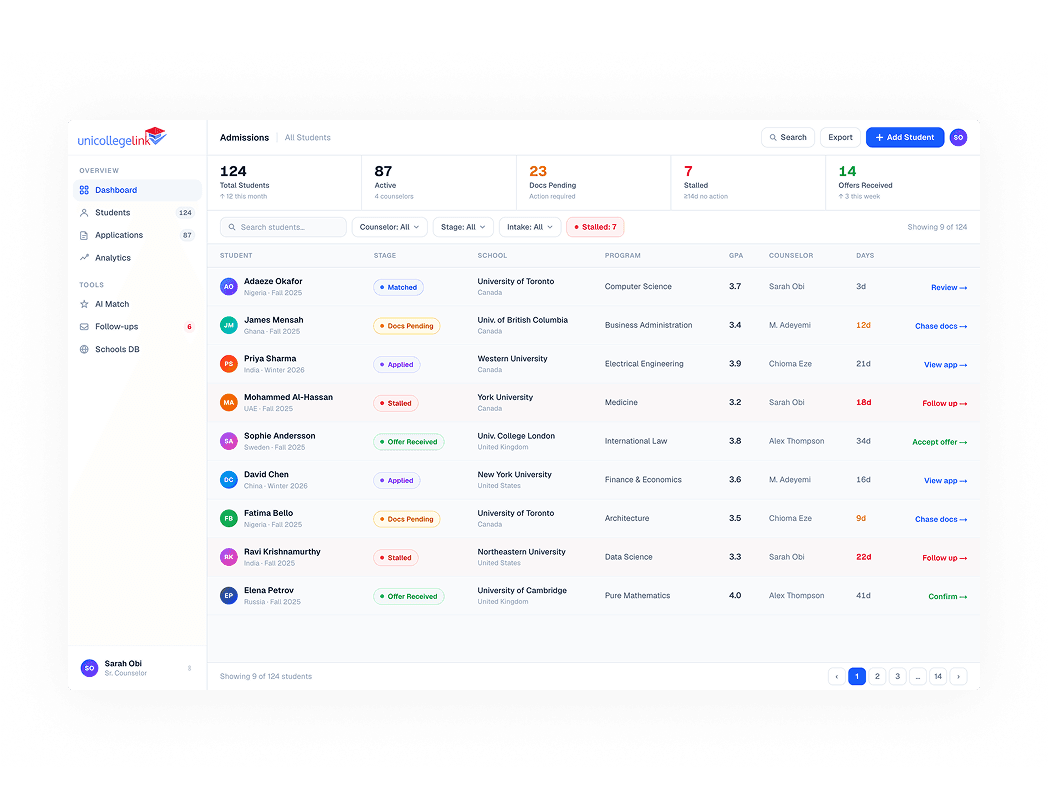
Counselor dashboard — every active student in the pipeline, with stage, stall status, and summary counts across the top.
Every match depended on who picked up the phone.
Before
A senior counselor knew which schools accept borderline profiles, which visa routes move faster, which programs were oversubscribed. A newer hire didn't. That gap showed up in the shortlists. And because nothing was tracked systematically, stalled applications sat quietly until a student called to ask why they hadn't heard back.
How data moves
A student submits a form. The form becomes a profile. The profile runs through the highlighted layers and lands in the counselor's queue — research already done.
Every partner school ranked before the counselor opens the file.
The matching engine runs the student's profile against every institution in the network across five factors: GPA alignment, language requirements, program availability, tuition range, and intake timing. The output is a ranked shortlist — fit score and a one-line rationale per school. Not just a list of names.
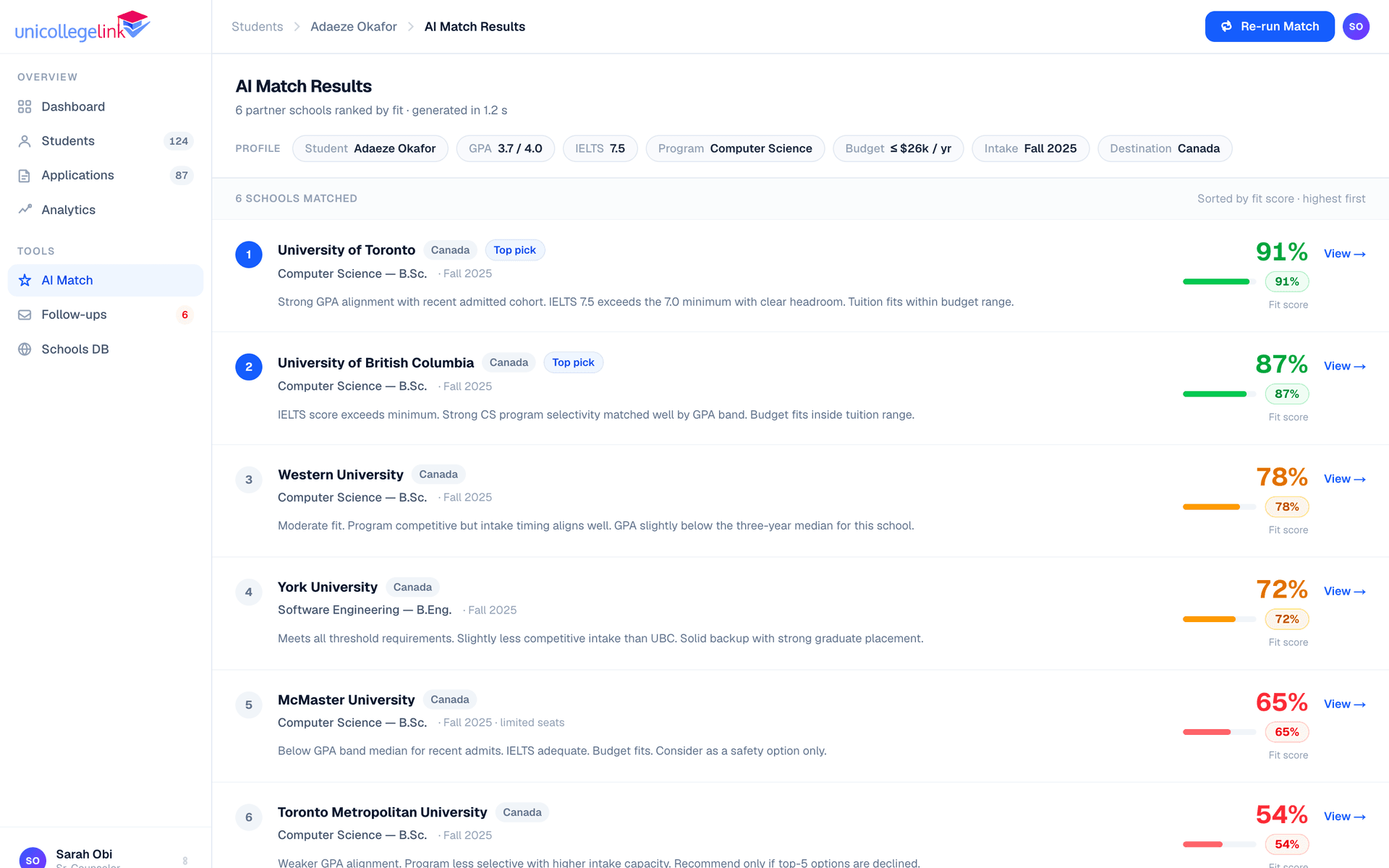
Match results — partner schools ranked by fit score, with program, country, intake window, and a one-line rationale on every row.
A number to reason from. Not a hunch.
Each shortlisted school gets a likelihood score drawn from historical acceptance data for comparable profiles — GPA bands, English score ranges, nationality, program selectivity. A counselor who sees '74% at University of Toronto' has a conversation starter. '74%' is a different conversation than 'this looks like a good fit.'
Example output
University of Toronto · CA
Computer Science
York University · CA
Software Engineering
Western University · CA
Computer Science
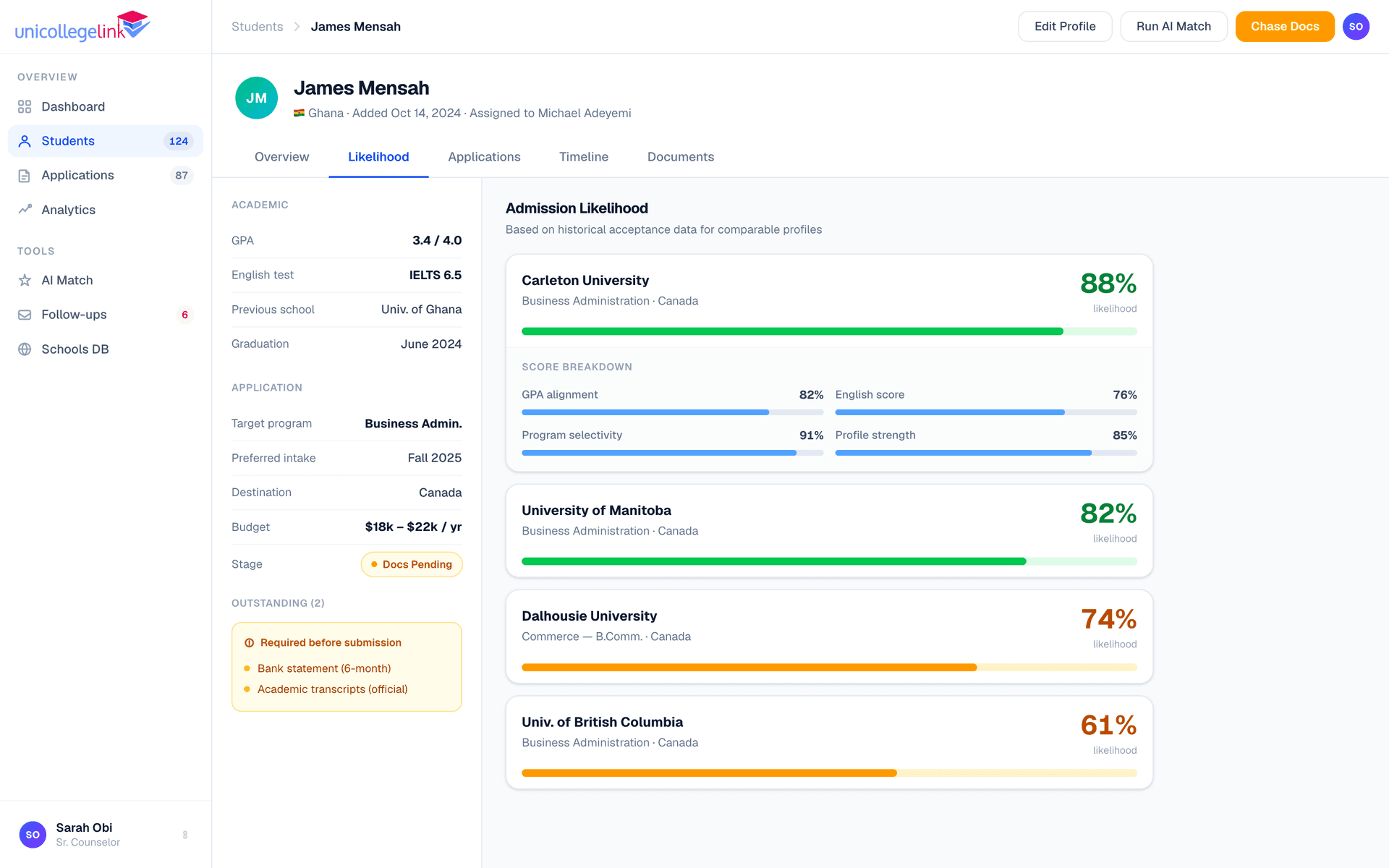
Likelihood scores — each shortlisted school with an admission percentage drawn from comparable historical profiles.
Every application. Every stall. One place.
Stage, days since last action, outstanding documents, upcoming deadlines — all in one view per counselor. The system flags stalled applications automatically. Nothing sits quietly for days without someone seeing it.
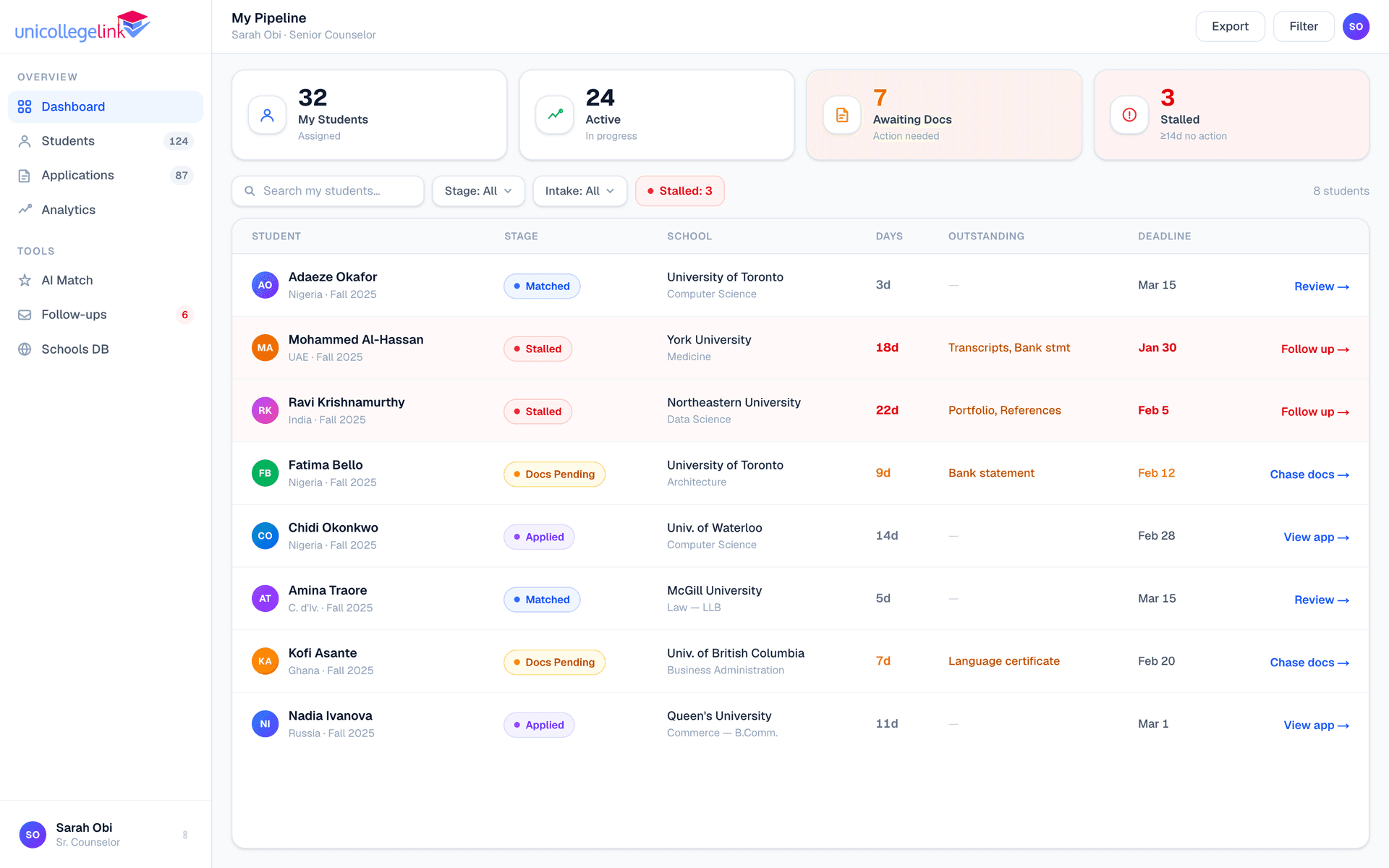
Counselor pipeline — applications by stage, days since last action, and automatic flags when a file stalls.
Days overdue
Triggers a stall flag automatically
Outstanding docs
Listed per application, not buried in email
Intake deadlines
Surface before they become missed deadlines
Drafts the email. Routes it for one click.
When a follow-up is overdue, the system writes it — student name, institution, and the specific outstanding item already in the body. The counselor reviews, edits if needed, and approves. Nothing sends without a human reading it first.
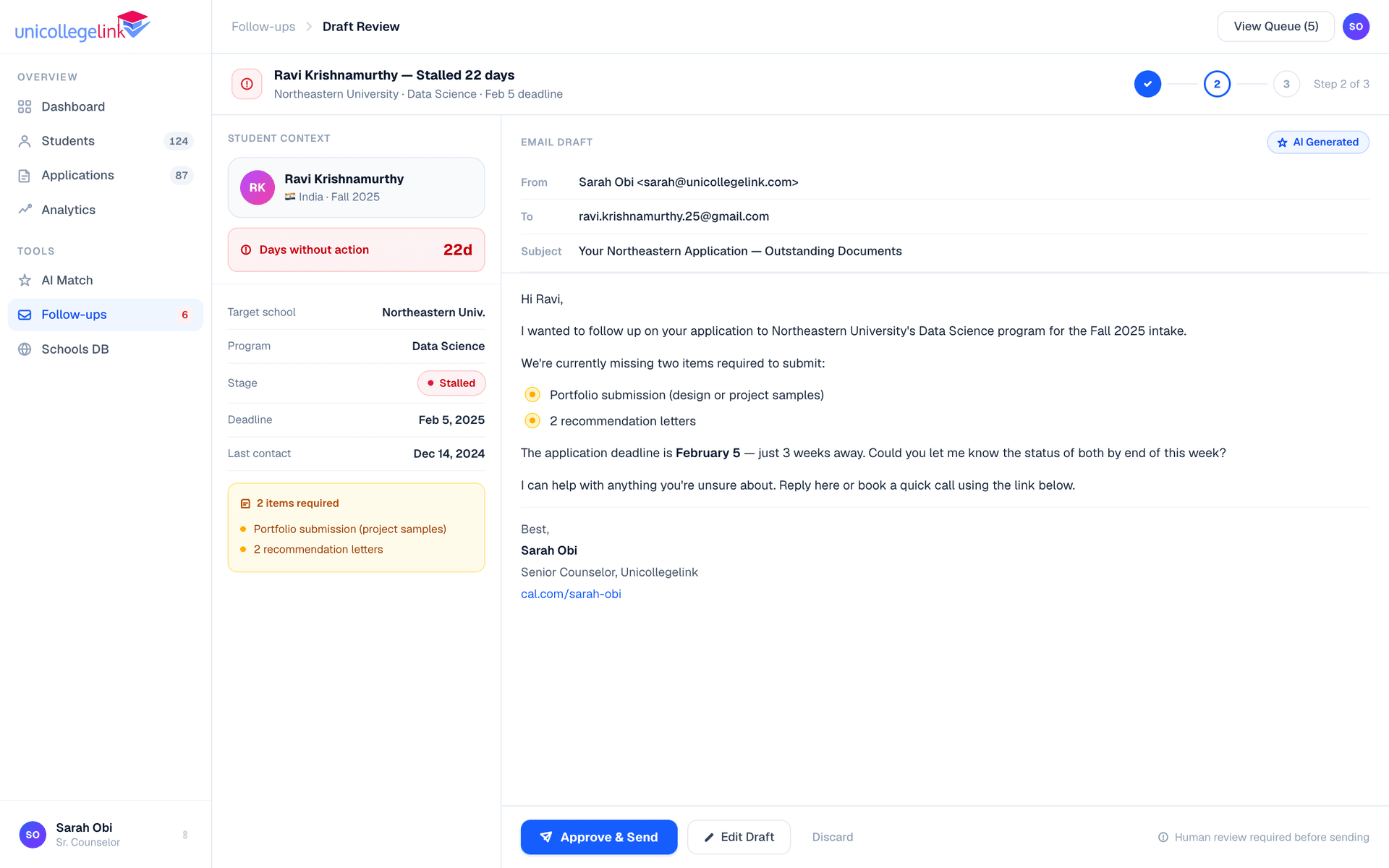
Follow-up drafts — student and institution context on the left, AI-written email on the right, ready for counselor review before sending.
What changed after four weeks.
The system doesn't replace counselors. It removes the parts of their job that were never really counselling — matching, scoring, tracking. Those are data problems. They're handled before a counselor opens a file.
“Before this, our value was in what our counselors had memorised. Now the system holds the institutional knowledge and our team holds the relationships. That's a better use of everyone.”
Japhet Ikuni
Co-founder & COO, Unicollegelink