Designed for the user who wants yield, not a blockchain tutorial.
SpoonFi is a chain-abstracted staking interface built around one idea: users have intents, not chain preferences. You say how much you want to stake and what outcome you're after. Solvers handle the rest — across however many networks it takes.

Timeline
2 weeks
Service
Products
Scope
UX / UI Design
Status
Concept
SpoonFi is a design exploration for what a chain-abstracted staking interface should look like — one that treats multi-chain complexity as an infrastructure concern, not a user problem. The design was built around a single behavioural insight: users want outcomes, not options. They want yield, not a decision tree about which protocol on which L2 at which APY.
Web3 staking asks users to do too much thinking.
To stake across chains today, a user has to: choose a protocol, select a network, understand the gas implications, bridge assets if needed, manage approvals, and repeat the whole process on every chain they want exposure to. That's a lot of cognitive overhead for something that is, at its core, a simple financial decision: I have assets, I want them to earn.
Chain abstraction changes the premise. The user's job isn't to pick a chain — it's to express an intent. The system's job is to figure out how to fulfil it. SpoonFi was designed to show what that user experience actually looks like when you build it properly.
Intent first. Complexity last.
Intent as the primary input
The first screen asks one question: what do you want to achieve? Not which protocol, not which chain — what outcome. Maximize yield, minimize risk, or fastest unlock. The intent drives everything downstream. Chain selection is available for users who want control, but never required. The default is: let the solvers decide.
Constraints: required and optional
Once intent is set, the user defines constraints. The staking amount is the only compulsory input — everything else is optional. Lock period (how long the assets are committed) and auto-renewal (whether the position rolls over automatically) are offered as optional controls for users who want them, invisible to users who don't.
Solvers: agents that compete to fulfil the intent
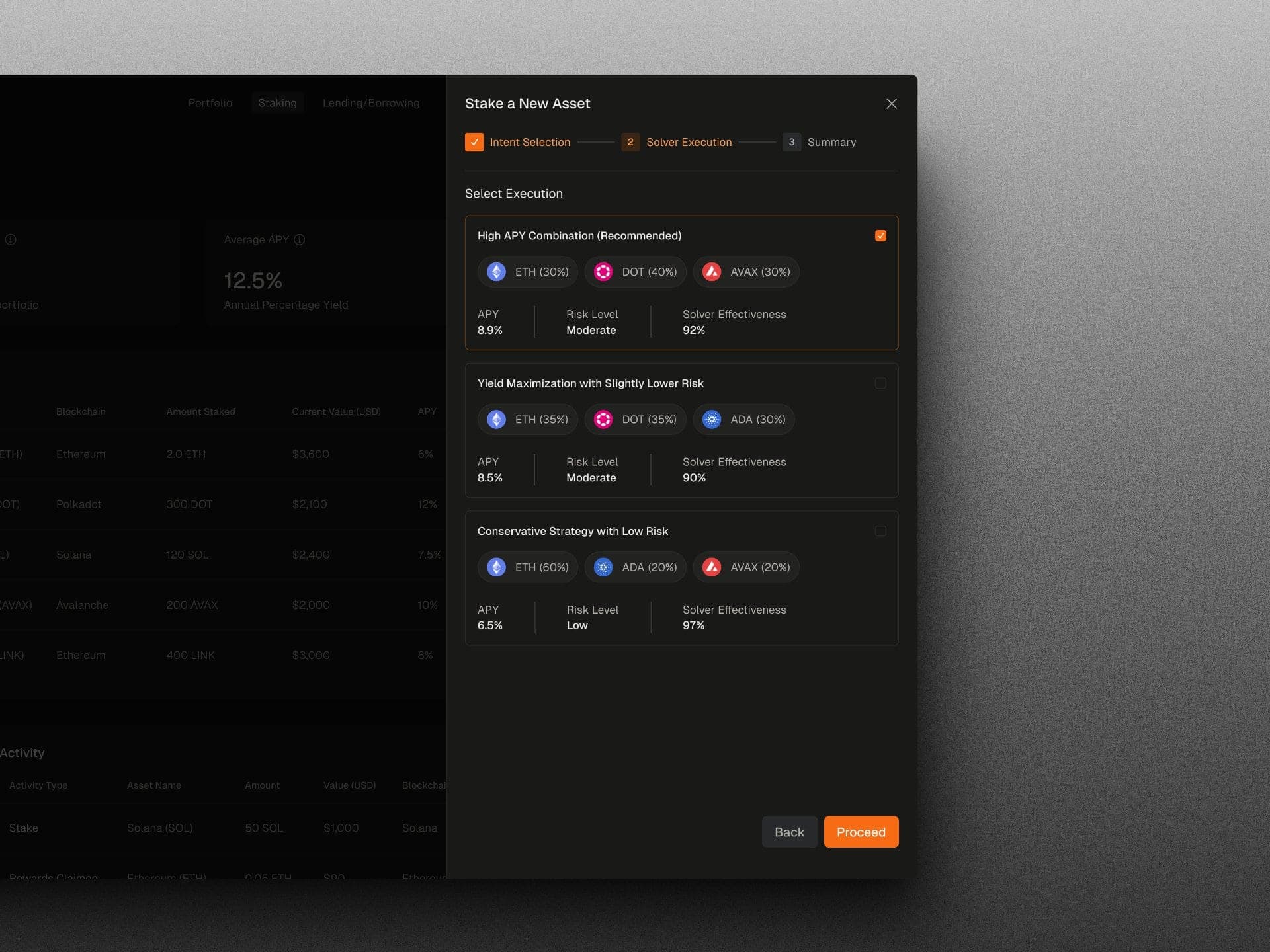
Solvers are agents that take the user's intent and execute it on-chain in the most efficient way possible. They can work collaboratively — pooling liquidity across protocols — or bid against each other for the best outcome. Either way, the user never sees that complexity. What they see is: three options, projected APY, estimated lock period, and a one-tap confirmation.
Options before execution
Before anything moves on-chain, the interface surfaces the top three solver proposals. Each one shows the projected outcome, the protocols involved, and the chains being used — enough for an informed decision, not so much that it becomes a research task. Users pick the option that matches their priority. Then they confirm once, and the solvers execute across networks.
Every screen removes a decision the user shouldn't have to make.
The design system is deliberately minimal — no token logos competing for attention, no chain icons as wayfinding, no jargon in the hierarchy. The interface looks like a fintech app, not a DeFi dashboard. That's intentional. The moment a user has to learn the product to use it, the abstraction has failed.


Chain abstraction only works if it's invisible.
The design validates a principle that applies well beyond staking: if your product requires users to understand your infrastructure to use it, you haven't finished designing it. SpoonFi is what happens when you take that seriously — a Web3 product that earns trust through simplicity, not despite it.
“Users should know but not care. Chain abstraction should let users understand what's happening at a high level — without making the understanding a prerequisite for the doing. That's the standard SpoonFi was designed to meet.”
Design rationale, August 2024